01 · Audience
Who this is for, and what you already do well
If you spend your time geolocating from satellite passes, breaking down witness footage frame by frame, cross-referencing social media against ground reports, or running open-source investigations that get submitted to courts and UN bodies — this toolkit is for you. Specifically:
- Investigators and analysts at established OSINT organisations (Bellingcat, CIR, BBC Verify and equivalents)
- Smaller and newer OSINT collectives without dedicated comms staff
- Comms leads at organisations where verification expertise sits separately from public-facing output
- Researchers integrating OSINT methods into adjacent fields (human rights monitoring, conflict documentation, fact-checking)
The premise of this toolkit
Existing communications guidance treats OSINT outputs as raw material to be simplified for general audiences. This toolkit takes the opposite position: your methodology is the asset. The work of verification — the geolocation, the timestamping, the cross-referencing — is what makes your content distinctive in a feed full of unsourced claims. Public-facing content that hides this process is throwing away its strongest competitive advantage.
What you already do well
Verification chains. Primary sourcing. Geolocation. Frame-level analysis. Methodology transparency. Institutional credibility. Detailed reports that withstand legal scrutiny.
What this toolkit addresses
Translating verified findings into short-form, social-native formats — quickly, without dilution, and within investigation workflows that don't necessarily include a comms team.
02 · Why this matters
Your reports reach institutions. Misinformation reaches the public.
The connection between public visibility and humanitarian funding is well established (Rost & Clarke, 2024). Crises that receive sustained social-media coverage attract greater funding and stronger diplomatic pressure. Crises that don't — Sudan, DRC, Haiti, Myanmar — consistently receive less of both, irrespective of severity.
OSINT organisations sit in an unusual position in this landscape. You produce some of the most carefully verified content available. You also reach almost none of the audiences where misinformation about the same events is doing its work. The reports go to courts, UN bodies, and policy briefings. The public sees the misinformation.
The gap is not in detection or verification — it's in translation. When verified content is slow, misinformation fills the vacuum. The four pillars below mirror the foundational toolkit's framework, deepened for OSINT.
03 · Verification as content
Showing your work is the work
Trust in news is at a historic low — only 40% of the public across 47 markets say they trust most news most of the time (Reuters Institute, 2024). In this climate, verified content is necessary but not sufficient. Audiences need a reason to believe it. Research by Curry and Stroud (2021) found that transparency in journalistic content directly increases credibility ratings. Showing how you know what you know — through sources, methods, and other evidence — is the mechanism through which Bellingcat and BBC Verify built public trust. BBC Verify's founding principle was to make the verification process itself publicly visible. Bellingcat publishes detailed methodology alongside every investigation. Both have demonstrated that showing the work is not a distraction from the story. It is the story.
"Where did you get that statistic from? And then it just kind of fizzles out. I'd rather see a source than have to ask where it came from."
Focus group participant, University of Bristol, 2025Minimum sourcing standards
Social-media audiences are more sceptical than traditional ones. Minimum sourcing standards build trust with your viewers and are the easiest thing to design into a template — set once, apply to every piece of content.
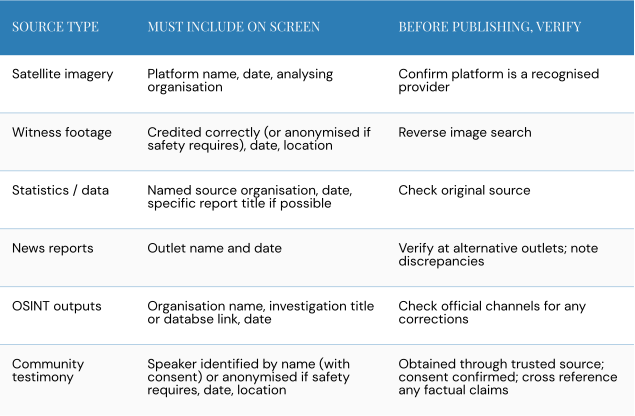
Showing your work, on screen
The tools and methods OSINT organisations already use can be brought into public-facing content without compromising rigour. Audiences find verification fascinating when it's narrated; they switch off when methodology is hidden behind organisational branding.
Do
- Walk audiences through the verification chain on screen, step by step
- Name your tools and methods (TinEye, InVID, Google Earth Pro, geolocation by shadow analysis)
- Distinguish between confidence levels: verified, likely, contested, unverified
- Acknowledge what you couldn't verify — gaps build credibility, not erode it
- Use consistent lower-third caption design so audiences learn to read your sources
Don't
- Compress methodology into “trust us, we verified it”
- Hide tools and methods behind organisational branding
- Conflate confidence levels for narrative tidiness
- Bury sourcing in pinned comments or video descriptions
- Use stock footage or unattributed imagery as B-roll — it undermines everything else
04 · Engagement without dilution
Making your content visible
The best story means nothing if nobody sees it. Video outperforms posts on every platform. Short-form video is sometimes treated as a synonym for dumbing-down — the research disagrees. Narrative framing consistently outperforms data presentation in driving emotional engagement and perceived relevance (Dahlstrom, 2014), and educative tone outperforms alarming tone for long-term audience retention. The question isn't whether to adapt for short-form; it's how to do so without losing what makes your work credible.
Four principles for short-form
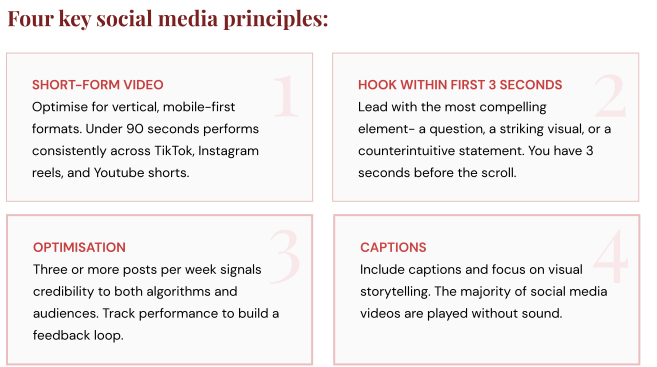
Three barriers to engagement
Primary research with young adult audiences (University of Bristol, 2025) identified three consistent reasons verified crisis content fails to land. OSINT content is particularly vulnerable to all three.
Emotional overload
Persistent exposure to distressing content depletes capacity to engage. Self-preservation, not indifference. Design for: sober pacing, educative framing, no shock-hooks.
Doom & gloom framing
Content that presents only severity without context or agency reads as a “barrage”. Design for: historical context, what's known and unknown, what comes next.
Helplessness
The feeling that individual awareness can't translate into action causes early disengagement. Design for: a clear “so what”, named pathways for action.
"When it's so doom and gloom, I find that quite hard to consume large amounts of it. When it's slightly more educative — yeah, it's easier to look at and to teach yourself about, rather than just hearing this barrage of the world's gone to shit."
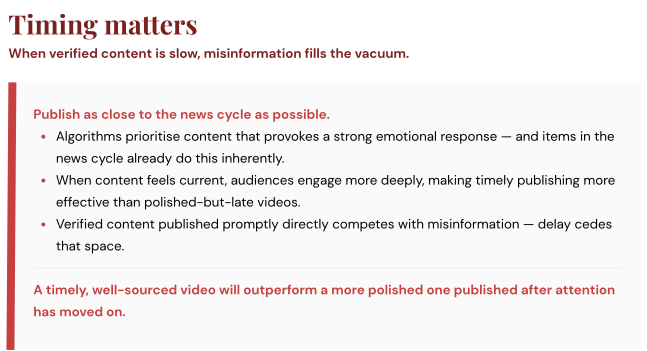
Focus group participant, University of Bristol, 2025Timing matters
When verified content is slow, misinformation fills the vacuum. A timely, well-sourced video will outperform a more polished one published after attention has moved on.
05 · Three video formats
Pick the format that fits your investigation
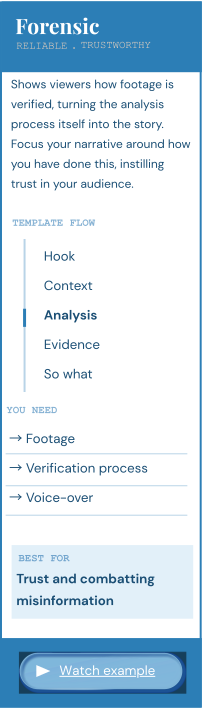
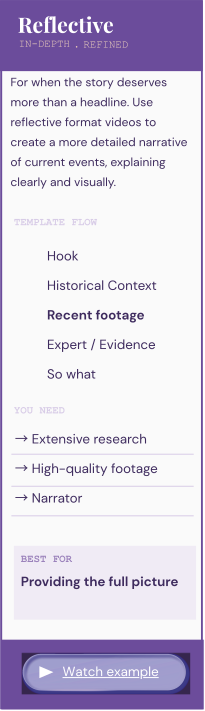
Your evidence needs a narrative. Analysis of crisis content that performs well on TikTok, Instagram Reels, and YouTube Shorts shows that the majority falls into three formats. Each maps cleanly onto a different kind of OSINT output. Whichever you choose: lead with a hook, assume no prior knowledge, educate don't alarm.
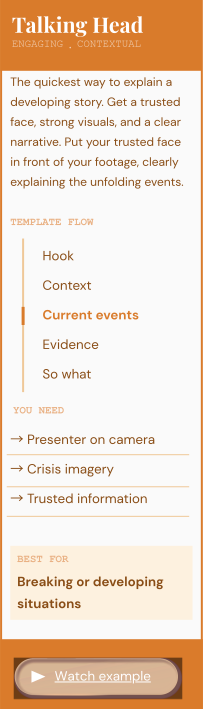
How each format maps to OSINT outputs
- Forensic — the natural format for OSINT. Use for breaking events, contested footage, and misinformation correction. Your verification methodology becomes the narrative spine.
- Talking Head — the explainer. Use for situation updates, translating long-form investigations into 60-second context, and putting a credible face on findings.
- Reflective — short-form documentary. Use for major releases, anniversary pieces, and pattern-of-conduct investigations that don't fit a 60-second window.
06 · Fair storytelling
A megaphone, not a microphone
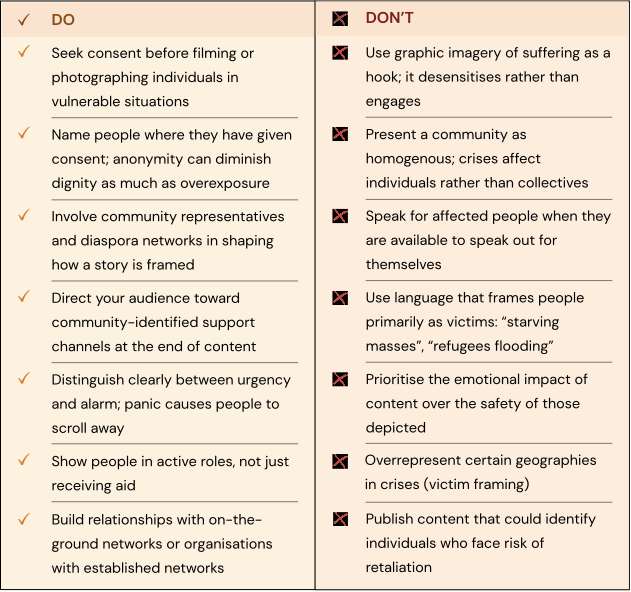
The most important ethical principle in humanitarian storytelling is also the simplest: your role is to amplify existing voices, not to write a narrative on someone else's behalf. This distinction, between amplification and extraction, separates storytelling which serves affected communities from storytelling that exploits them. OSINT organisations sit closer to communities than the institutional outputs sometimes suggest — verified evidence often originates from the people closest to the harm. Public-facing content needs to reflect that.
"How can one give something the recipient already has? One may amplify it, centre it, or represent it accurately — but one does not give it. We have a moral responsibility to listen, respect, amplify, centre, and, whenever possible, pass the mic."
Dr Malaka Shwaikh, LSE, 2021Content that portrays affected people with agency and dignity is both more ethical and more compelling than content that abstracts their suffering. The principles below are drawn from established humanitarian communication standards and STORINT's primary research.
07 · Workflow
Building a comms function without a comms team
Reviewer feedback identified a specific need: smaller and newer OSINT collectives — the ones doing some of the most agile work in the sector — often don't have dedicated communications staff. Hiring one isn't always realistic, and bringing in an external agency rarely produces output that respects verification standards. This section is for those organisations.
The principle is to build social-facing output into existing investigation workflows, using people you already have. Verification artefacts that already exist (geolocation maps, frame breakdowns, source tables) become raw material for content; investigators who already understand the work narrate it; a lightweight publishing process replaces a dedicated comms function.
How it fits together
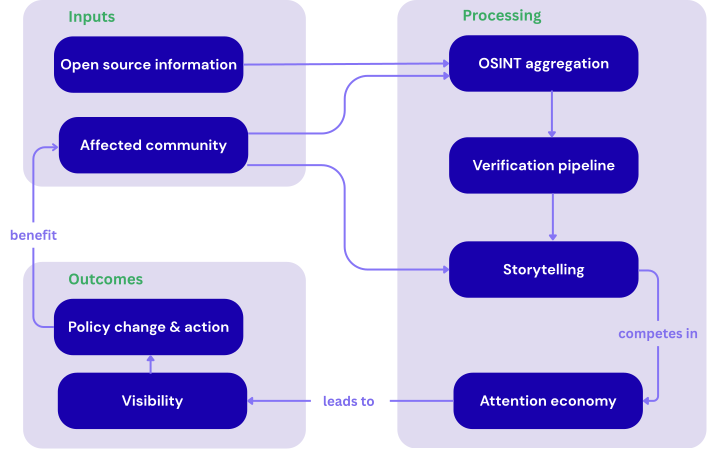
The four-stage workflow inside your team
Investigate
Verification artefacts produced as normal: geolocation, source table, frame analysis, confidence statement.
Translate
Investigator drafts a 60–90 second narrative using the format template that fits.
Edit
Apply on-screen sourcing template, captions, verification chain visualisation. Tooling stays light.
Publish
Within the news cycle. Track performance. Feed insights back into stage 02 templates.
Roles, with no new hires
Who does what
Investigator drafts the narrative version of their own investigation — nobody understands the verification chain better. One team member takes on editing and publishing as a rotating responsibility, supported by templates. The org sets cadence, tone, and review standards.
Cadence to aim for
Three short-form posts per week as a target. A reflective release every 2–4 weeks. Daily posting is not the goal — consistency and verification standards are. Publishing windows tied to news cycle, not weekday office hours.
Tooling deliberately kept light: a video editor (CapCut, DaVinci Resolve, Premiere), a captions tool, a shared template library, and a source-tracking sheet. This pillar avoids recommending bespoke comms platforms — investigators won't adopt them.
08 · Checklist
Before you hit post
A pre-publish checklist designed to be run in under five minutes, by the investigator who produced the content. Anything that fails should block publishing.
Sourcing & verification
- Every figure on screen is attributed to a named source with a date
- Every piece of footage carries platform, date, and verification method as a lower-third caption
- Confidence level is named explicitly: verified, likely, contested, unverified
- Anything that couldn't be verified is acknowledged on screen, not hidden
Engagement & format
- Vertical aspect ratio, mobile-first framing
- Hook lands inside the first three seconds
- Captions on by default and accurate
- Tone is educative rather than alarming — pacing, music, language all checked
- A clear “so what” at the end, not a fade-out
Safety & ethics
- No content that could identify individuals at risk of retaliation
- Consent confirmed for any named witness footage
- Affected communities portrayed with agency, not only as recipients
- No graphic imagery used as a hook
09 · Iteration
This toolkit is an early working draft
The version above has not yet been through formal co-creation with sector partners. It is built on STORINT's foundational four-pillar framework, primary focus group research at the University of Bristol, and reviewer input from the April 2026 innovation showcase — including direct feedback from leadership at the Centre for Information Resilience, Action on Armed Violence, and academic partners at SOAS, Birkbeck, and the University of Bristol.
The next iteration will be developed with practitioners. If you work in OSINT and want to shape what's here — including disagreeing with any of it — we'd like to hear from you.
Want to shape the next version?
This toolkit improves the more practitioners stress-test it. Share what works for your team, what doesn't translate to your context, and what's missing.
Share feedback Get in touch